Thawed Embryos, Reproductive Rights, and the Grey Marshlands of Ethical Ennui

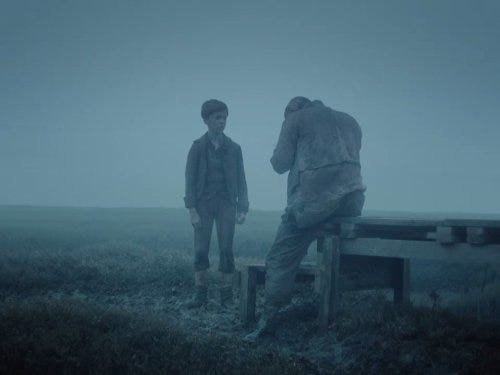
“The marshes were just a long black horizontal line then …and the river was just another horizontal line, not nearly so broad nor yet so black; and the sky was just a row of long angry red lines and dense black lines intermixed. On the edge of the river I could faintly make out the only two black things in the whole prospect that seemed to be standing upright; one of these was a beacon … the other, a gibbet with some chains hanging to it which had once held a pirate. The man was limping towards this latter, as if he were the pirate come to life, and come down, and going back to hook himself up again.”
And so ends chapter one of one of the most memorable English language novels, Great Expectations. Charles Dickens was an early master of utilising location to express the human condition.
The sheer liminal greyness of the Kentish marshlands as the story opens with our hero Pip caught between death and life. He has just passed through a graveyard and finds himself on the marshes.
The landscape’s refusal to confirm a fixed horizon. The muddied intent. The sheer dreariness and ennui, even as danger lurches out of the fog in the form of Magwitch.
Is anything living? Is everything dying? Who is to say? We are constantly caught between, as Dickens intends for so much of the novel, with those great exceptions forever just over the horizon.
Then as if to double down, the subsequent appearance of the fantastical Miss Havisham, locked way as she is into an always impending marriage, as all around her - and within her - crumbles and decays.
The stern liminality of it all is reflected in an exceedingly well-written, and bravely offered, essay in The Weekend Australian, by Sascha Callaghan.
Callaghan writes after having picking up her unused - and now thawed and quite dead - surplus embryos. And as she does, she finds herself struggling to find a fixed horizon to lock in her response to it all.
Why? Because, as I suspect is the case for many women, the space between the white-hot fervour of both sides of the abortion/reproductive rights debate, is more akin to the marshlands of Dickens’ novel. Ethical categories have been absorbed in modernist mist.
While the bright sunshine of certainty burns off the fog of the “Shout Your Abortion” crowd, and it has to be said, parts of the pro-life crowd, there is a vast marshland , in which women - and yes, men too, - are trudging across a smudgy ethical landscape, looking for certain convictions about this matter - indeed about any matter - and finding none.
Callaghan has a dilemma. Her dilemma is that as she pops into a medical centre, - having been told that the embryos will soon be disposed of if she doesn’t collect, - she senses there must be ethical certainty about her decision.
Yet to her dismay she can locate none within herself. Or without. She lives in the aorist tense, constantly searching for a fixed location, but finding it just beyond her.
This was so unlike her experience in past. Following an abortion some two decades prior that threatened her career and her idea of her future, she sensed the disapproval of the GP. The mood was sombre inside, as were the small gaggle of protesters outside.
She felt - she says - “sad about the process”. The smell of judgement was, if you like, something of a spur. A negative something perhaps that would enable her to lean into righteous conviction, but something nonetheless. Something to push back on.
Now? Two decades later? Nothing. The sheer Scandinavian efficiency of it all disturbs her, as modernism often does, but always too late.
There is no opposing force to push back on culturally, at least not in any meaningful way.
Some 20 years later, I went to pick up six dead – unalive? – little embryos floating in fluid-filled straws from the IVF clinic. This solemn errand, which I had put off for too many years after we’d completed our family (one IVF son, and one naturally conceived one), barely registered a moment’s concern from any person near to me. This included my husband, the clinic staff, or any of those inclined to protest about the fate of fetuses. I might as well have been picking up the dry cleaning. So I proceeded glumly and alone to perform this sad little duty no one had any words for. Six little individuals in vitro, second-class unborn to the protesting types I guess, had been left to turn into a puddle on the lab bench, and I had decided – in what was framed by those around me as a bizarre choice – to go pick them up. No one knew what to make of it; it was one of those strange new modern things we simply have no cultural framework for.
Callaghan is disturbed that no one is disturbed. The quality of her writing is such that there are no histrionics, no large flourishes, just simple observations. And as all writers know, it’s the little details that give the weight:
Why all this sentimentality now and not all those years ago at the abortion clinic I cannot say. Maybe it was because the termination was already so serious and full of mourning that I could resolve my ambivalence with a shot of defiance and feminism. But this was full of … nothing.
The lab tech handed me a little box full of defunct peoplings that were kind of my family, and I went on my way. There were no protestors outside to witness my guilt. No admonitions I could courageously take on the chin and complain about in women’s circles. No one to regret it with. When I got home I noticed they were numbered 1 to 7, with straw 4 (my son) missing. I wondered if the doctor had paused for a moment over them before choosing. How close was it to being number 3 and not him?
Full of nothing. That’s Dickensian. And no one to regret it with. We have so parsed our ethical horizons, so blurred our understandings of rights, that Callaghan realises that there is no longer a community to share her grief or misgivings with. Indeed to do so would be tawdry. Non-modern.
So what is she to do? Perhaps what we all do with trinkets to which we attach great value but which no one else considers of consequence. It’s worth nothing to anyone. But to us? We can’t price it, but its weighty costliness is in there somewhere.
Callaghan explains:
I put them in my undies drawer five years ago, and there they have remained. Never had embryos felt so viscerally close to being “a baby”. I still do not know what to do with them.
For years I kept my father’s old silk scarf, a striking peacock black and blue, with one annoyingly fraying end, in my undies drawer. Or should I say drawers. I have moved often, but that scarf has stayed there, since the day I discovered it in the box of things Dad had forgotten to take with him. It means something, but like Callaghan observes, just exactly what?
It would have been nice if a protestor had thought to scowl at me or pray for me in honour of the six in the box. But no one really cared. No one seemed to be able to grasp the nature of the act — what it was and what it meant. Not me, or policy makers or the religious folk who care about these things. Honestly that seemed worse.
Callaghan contrasts the two non-marshland sides:
What pro-lifers get wrong is to overstate the relative value of an embryo compared with its mother…What the pro-choice crowd get wrong is to frame abortion as morally neutral – as a matter of mere “health care” like a tonsillectomy, or a teeth cleaning, or picking up IVF embryos.
I disagree from first principles with the “relative value” argument, yet it makes sense of the ethical marshlands of our modern secular time. The sheer horror of sex-selective abortion being given an airing in our Parliaments in Australia demonstrates that we not only parse unborn and born life, we parse the types of unborn life too.
Yet I get her dilemma. Her liminal entrapment. Her ethical confusion is a perfectly well-formed assumption to make. And it aligns with Philip Reiff’s ideas about anti-culture: the concept that cultures are defined by what they forbid.
For Callaghan? She recognises that when it comes to reproductive rights, the culture forbids nothing, even while her God-fashioned body is viscerally seeking cultural propulsion or pushback.
But, alas, those days of certainty - even if it were scowling certainty - are over. The fact that she cares at all is a problem. Her problem. Is she looking for therapy? Is she seeking absolution? Who can tell. And who can offer it anyway?
Callaghan is insightful enough to realise that she has reached peak freedom in the modern West. This is the top of Mount Progress, where the air is clear and the stale, gassy marshlands of religious restriction and ethical certainly are far below.
She knows that should be experiencing great expectations, and enjoying what she has with nary a thought of anything else. But the undies drawer must be opened every morning.
Callaghan cannot see the supposed vista. Sixty years of one-way traffic in our legislation, arts, politics, education, social imaginary, and still she is unconvinced. It’s as if we were created for far more.
It’s as if to create something - someone - and then leave them in suspended animation, is to curse them to the soulless drudgery of an ethical marshlands of our making.
And in a supreme irony, it is Callaghan in particular who is left in a state of suspended animation - much like those foetuses - those tiny humans. And, as all good writing does, her piece draws us into that reality as well.
Here we all are in the anti-culture, ethically suspended between who knows where, caught between important life-changing decisions that we are told do not amount to anything, but which feel like they ought to.
Callaghan ends with this ethical admonishment to the anti-culture that would reduce all such decisions to their convenience factor:
These questions about the meaning and value of early human life, and the phenomenon of motherhood, persist as we grapple with new situations – from commercial surrogacy to artificial wombs, to the use of embryos for research and beyond. The truth about women, embryos, pregnancy and birth is deeper, harder, and less convenient than you think.
I said yesterday that I would write a piece on abortion, but this seems more complex than that, even as I hold to the fact that abortion is a great wrong, a rejection of God, and that IVF embryos that are surplus to human requirements are greatly valued by God.
And I suspect that the majority of Westerners are trudging through the grey, ethical marshlands that I have described, half inclined to celebrate the fact that there are no convictions around this matter (and indeed no actual convictions), yet unwilling, as it were, to remove the foetuses from the undies drawer and wash them down the sink.
So they, like those tiny humans, will continue living in the aorist tense, doomed to strive for great cultural, ethical and moral expectations, that will stubbornly never arrive.
This is the cultural inheritance that Sascha Callaghan has been bequeathed. It’s been hammered into her head - and ours - that such decisions are the sunlit plateaus of peak freedom.
Yet we are like the pirate of Pip’s imagination. We in the West, having been given freedom in the living and life-giving gospel, in whose power the Spirit blew the anti-cultural death-works away, have returned to the gloomy gibbet to hook ourselves back up again.
**********************
I received this DM yesterday in light of me signalling this Substack article. It’s very helpful as we think through these things:
We are a Christian couple who can’t have their own biological children. We have been so blessed to be gifted embryos from another Christian couple who used ivf to have 2 children, are unable physically to have more children, but had embryos they believed were potential lives and they were not willing to have them discarded or used for science. We now have our little daughter because of this amazing gift.
Many people with ‘extra’ embryos are not told they can donate them, although it’s slowly becoming more common. Unfortunately the demand for embryos is huge as anyone, single, SS couples etc, are able to access them. There are also, sadly, hundreds of thousands of embryos suspended in time around the world, and clinics are overwhelmed with the need for space to keep them all in storage.
There are Christian agencies in America which are specifically for this type of adoption. They are often known as snowflake babies, or snowflake adoptions, because they are little frozen bubs at adoption.